George’s flock
Three Bags FullGeorge’s flock is both a pastoral community and an investigating body: after George Glenn is found dead with a spade in him, the sheep who depended on his care begin to ask what happened and what they owe him. Their shared life rests on routines of grazing, storytelling, and protection, but his absence exposes how much of that life depended on a shepherd. As the flock faces rival claims to the meadow and the prospect of a journey to Europe, collective action becomes its way of defending both its home and its future.
Life Under George
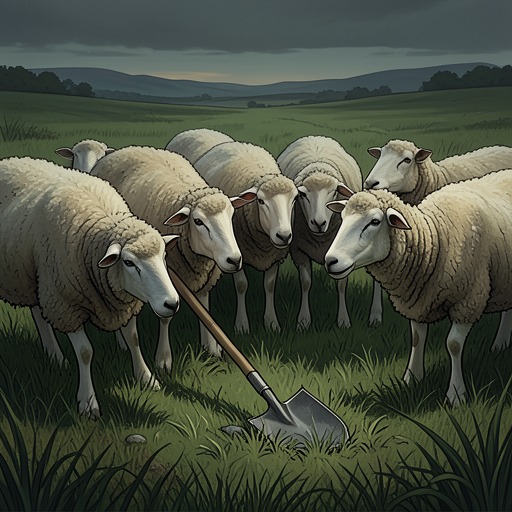
The flock first appears in a meadow near the hay barn, gathered for a meeting not far from George’s body. A crow has settled on his Norwegian sweater, a rabbit sits nearby, and the sheep are keeping their distance from the cliff edge. They are proud that they have stayed calm after finding him cold and lifeless. Their alarm is practical as well as fearful: they wonder who will bring hay, until Miss Maple points out that midsummer grass is abundant and that a wolf would not normally kill with a spade. Sir Ritchfield, the oldest ram, makes the decisive distinction that George did not die of illness: a spade is not an illness.
The flock’s bond with George comes from repeated acts of care. He came to the meadow early, laughing when Tess had to rouse the sheep from their close-packed sleep, and called them lazy before they went out to graze while he worked in the vegetable garden or made repairs. By afternoon they gathered by the steps of his caravan for his readings. He offered them fairy tales, a book about sheep diseases, and a detective story he abandoned halfway through, leaving its murderer unidentified. Most often he read romance novels about red-haired heroines, a choice that gave him an outlet for anger at red-haired women, especially his wife. The flock’s memory of him therefore includes not only a shepherd’s labor but also the intimate, imperfect rituals through which he shared the meadow with them.
George’s absence immediately changes their conduct. The following day, with no shepherd or sheepdog, they hesitate before leaving the barn; Mopple the Whale’s hunger finally gets them moving. They then raid the fenced garden behind the caravan, opening its bolt and devouring its lettuces, peas, radishes, cress, tomatoes, endives, buttercups, and chives. Their shame afterward is as telling as the raid: they return to the meadow, while Othello, who did not join in, draws Miss Maple’s attention to the place where George’s garden spade should have been. The missing tool links a familiar piece of George’s work to the violence of his death.
Investigation and Internal Strain
For the flock, George’s killing is not simply a puzzle. Miss Maple argues that he had tried to find the culprit when a fierce dog took one of their lambs; because he was their shepherd, they owe him the same effort. She names the act murder and rejects the idea that anyone had the right to put a spade into him. Othello, the flock’s only black sheep, adds a different perspective: having spent his youth in Dublin Zoo, he reasons that a human—or a very large monkey—must have done it. The inquiry begins in a community whose members understand justice through the care and protection George had shown them.
Their search unfolds alongside human explanations of George’s life. In a conversation overheard by the sheep, Harry the Sinner and Josh speculate that drugs might be hidden on the land; Tom O’Malley describes boats arriving at the beach by night and the material being taken to the caravan before George drove away in his car. The men also resent that George kept people away from the land and refused offers to develop its view for tourism. The flock hears these claims against the memory of a shepherd who worked in his garden and read to them, making the conflict over his land inseparable from the question of what kind of life he had concealed from them.
The flock is not always secure in its own cohesion. At one point a small group of daring sheep gathers behind the caravan, out of Sir Ritchfield’s sight, considering leaving. Elsewhere, when Ritchfield’s failing memory becomes alarming, the sheep do not know how to help him: Miss Maple and Othello are absent, Mopple withdraws for fear that memory loss might be infectious, and Zora retreats to her rocky ledge. Rameses takes charge by leading the flock far enough away that Ritchfield cannot hear them discuss what to do. Their response is practical rather than triumphant; they recognize the danger and seek room to plan, even as their oldest ram becomes vulnerable.
Pasture, Rivalry, and Collective Defense
The arrival of Gabriel’s flock makes territory a daily issue. Gabriel’s dogs gather the newcomers behind a wire fence, shrinking the meadow available to George’s sheep. Maude objects that the new boundary reaches the place where mouse weed grows; the flock is troubled less by the plant than by the principle of losing ground. They also regard Gabriel’s sheep as strange: short-legged, long-backed, pale, restless, and covered in dense down rather than ordinary fleece. Their difference prompts a practical question about why Gabriel keeps sheep that do not grow wool.
The answer changes the meaning of the rivalry. Gabriel says his sheep eat a great deal and must be fattened. After repairing the fence, he takes George’s scythe from the toolshed and cuts grass at the foot of the hill. George had polished the blade but said that people who kept sheep could spare themselves its use; Gabriel uses it on the pasture and for the sheep. To George’s flock, the human with the iron tool seems to graze while destroying the grass he does not eat. The cut blades lie flat, and the smell of them intensifies the sight’s horror. Their pasture is not simply shared space: it is a resource being managed for a different end.
The threat to George’s Place turns resentment into a decision to defend it. The flock has voluntarily given up grazing there as a memorial, and the thought of Gabriel’s sheep consuming that grass makes the loss feel like an insult to George as well as an encroachment on their land. Led by Mopple, they go to the place, initially unsure how sheep can defend a meadow against other sheep. The encounter becomes pushing and resistance, but the sheep who are nipped sound so hurt that George’s flock does not want to answer with violence. Then Gabriel’s sheep stop and listen as a dark body circles them in the night. The flock later cannot recall the action precisely; it remembers flight, panting, crowding, scattering, and a sense that there was always another step to take. In the end, George’s flock is back in the hay barn and Gabriel’s flock behind its wire fence. Lane stands on the cliffs, her eyes shining with admiration, after having watched the night’s masterful herding.
Leadership and the Future
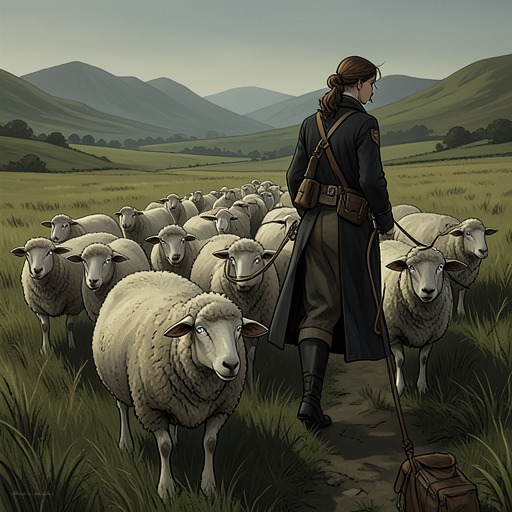
George’s will makes the flock a legal beneficiary as well as a community in need of care. The lawyer says that George leaves his remaining fortune to the sheep so that they can go to Europe as he promised. The lawyer will administer the money, but the animals need an authorized representative to accompany them as shepherd, with rights and duties set out in the will. When asked who wants the position, Gabriel offers himself; the lawyer accepts the offer. The flock’s future therefore depends on a human representative, even though the sheep themselves have repeatedly shown that they can judge threats and act together.
Later, Rebecca reads aloud a story about a little girl with two fathers, one secret and one acknowledged. In the tale, the girl and her secret father quarrel, stop speaking, and are separated until a letter arrives saying he intends to travel to Europe and first wants to see her. The girl hides her joy and keeps him waiting; he waits himself to death. The sheep hear a story that brings affection, estrangement, a missed reunion, and Europe into the same account. As Rebecca sits with an open packet of grass beside her, Mopple takes and eats its contents before she notices. That small, concrete act sits beside the larger promise of the will: the flock’s future is imagined as a journey, but its life remains rooted in appetite, memory, and the shared place it has worked to protect.
Narrative Significance
The flock’s organization is made visible through acts of care rather than formal institutions: George’s morning work, his readings, Miss Maple’s investigation, Rameses’s effort to make space for a frightened discussion, and the sheep’s defense of memorial pasture. Their collective perspective also unsettles the appearance of a tranquil pastoral landscape. A green meadow contains a murder, contested land, animals being fattened for slaughter, and a human tool that cuts grass without consuming it. The flock’s responses do not erase their dependence on human decisions, especially the will’s requirement for an authorized shepherd. They do show that dependence is not the same as passivity: George’s sheep interpret what happens to them, remember the care they received, and organize themselves to protect what matters.